Instructions
If the Project is a house, then Work Packages are the rooms of a house and Tasks are the furniture and the people in those rooms.
Work Packages refer to larger individual pieces from which the proposed work is built. The number of work packages should be proportionate to the scale and complexity of the project. Besides the work itself, you must have one work package for the communication and exploitation as described in Chapter 2.2, and one Work Package for project management that includes day to day management, reporting, managing finances, risk management and innovation management.
Each work package is divided to tasks. In the task descriptions you should give enough detail to justify the use of proposed resources and give quantified information so that progress can be monitored by the project partners and the Commission. Rather be too specific and detailed, than less so. Evaluators see that the more detailed the task is, the more thought, planning and expertise is put into it.
Resources you assign, including person month effort, should be in line with the work, and be proportional to the objective of the work package so it can be achieved.
There is no minimum/maximum value to how many person months to allocate. It should be enough to get the work done. It is also good to balance the effort between work packages, so if one Work Package is significantly smaller than the others, it may be e.g. included as a Task in another Work Package.
Some guidelines:
- Name should be clear and descriptive of the work done in the Work Package. Try to avoid acronyms.
- Start and End months refer to Project Months calculated from the start of the project. Do not have each task start from Month 1 and end at Month 48. It shows lack of planning.
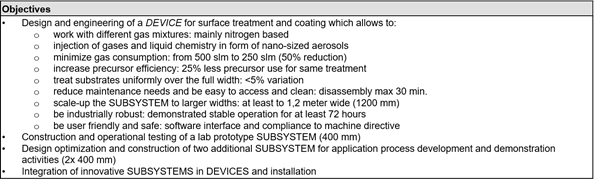
- Objective is what the optimal outcome of the work is. Include a measurable target.
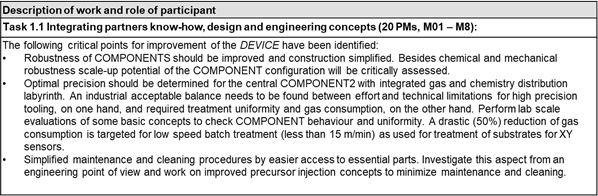
- Description of work describes the work. It should be divided to tasks that list the lead partner and the role of each partner participating in the work in the task.
- Do not add in motivation or background. Those are handled in Chapters 1 and 2 already.
- Deliverable is the concrete outcome that a task produces.
- You have to have at minimum one deliverable for each reporting period the Work Package runs. You can plan for one deliverable per work package per year minimum.
- It is also good form to end each task with a deliverable, as a task that continues after the deliverable begs the question, why is the extra time needed if the result is already given earlier?
Remember: The Work Packages also include:
Table 3.1a that lists the Work Packages in order by number and includes Work Package name, leading organisation, effort and duration.
Table 3.1c that lists the deliverables in the order of delivery date.
Example
Table 3.1b