Unlike other EC funding schemes, the EIC Accelerator is eminently business-focus: a big mistake would be to focus your proposal solely on the innovation and treat superficially the business aspects of this: in the own words of evaluators (see our own post here), this will doom your proposal.
In order to define properly a frame for defining the business side of the project in H2020, the following definitions have to be considered in a cascading order:
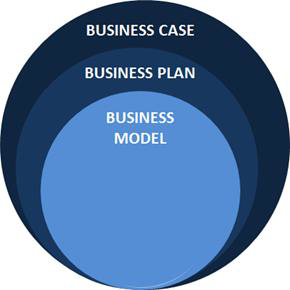
A business case. A business case captures the reasoning for initiating a project or task. The logic of the business case is that, whenever resources such as money or effort are consumed, they should be in support of a specific business need. A compelling business case adequately captures both the quantifiable and non-quantifiable characteristics of a proposed project and typically account for information on the background of the project, the expected business benefits, the options considered (with reasons for rejection or selection per option), the expected costs of the project, a gap analysis and the expected risks. From this information, the justification for the project is derived.
In the public sector in general, and in H2020 in particular, the business case is argued in terms of Cost–benefit analysis, which may include both financial and non-financial cost and benefits. This allows the business to take also into account societal and environmental benefits, allowing a more comprehensive understanding of economic impacts. In terms of business, it is limited to a general view and understanding on the business operations and it is very common to be requested in Research and Innovation actions (RIA) and Innovation actions (IA).
A business plan. A business plan is a formal written document containing the statement of the goals of a business and the plans for reaching them under a variety of perspectives (finance, human resources, intellectual property management, supply chain management, marketing…).
Apart from raising funds, the primary purpose of a business plan is to define what the business is or what it intends to be over time. Clarifying the purpose and ultimate direction of the business allows you to understand what needs to be done for forward movement with the clear target in the horizon.
Under H2020, when a business plan is required within the project proposals or under the project execution it typically covers 7 key questions:
- What does the business do?
- Which is your industry, market, and competitor landscape?
- How is the business organized?
- What is your offer?
- How are you selling your product/service?
- How much money you’ll need for next 3 to 5 years?
- How the business will be profitable?
The depth of the answers to these questions is fully dependent on the H2020 instrument. While in RIA and IAs, it is covered within the impact section with higher details in IAs than in RIAs, in FTI and the SME instrument, these questions are the basis of the overall template.
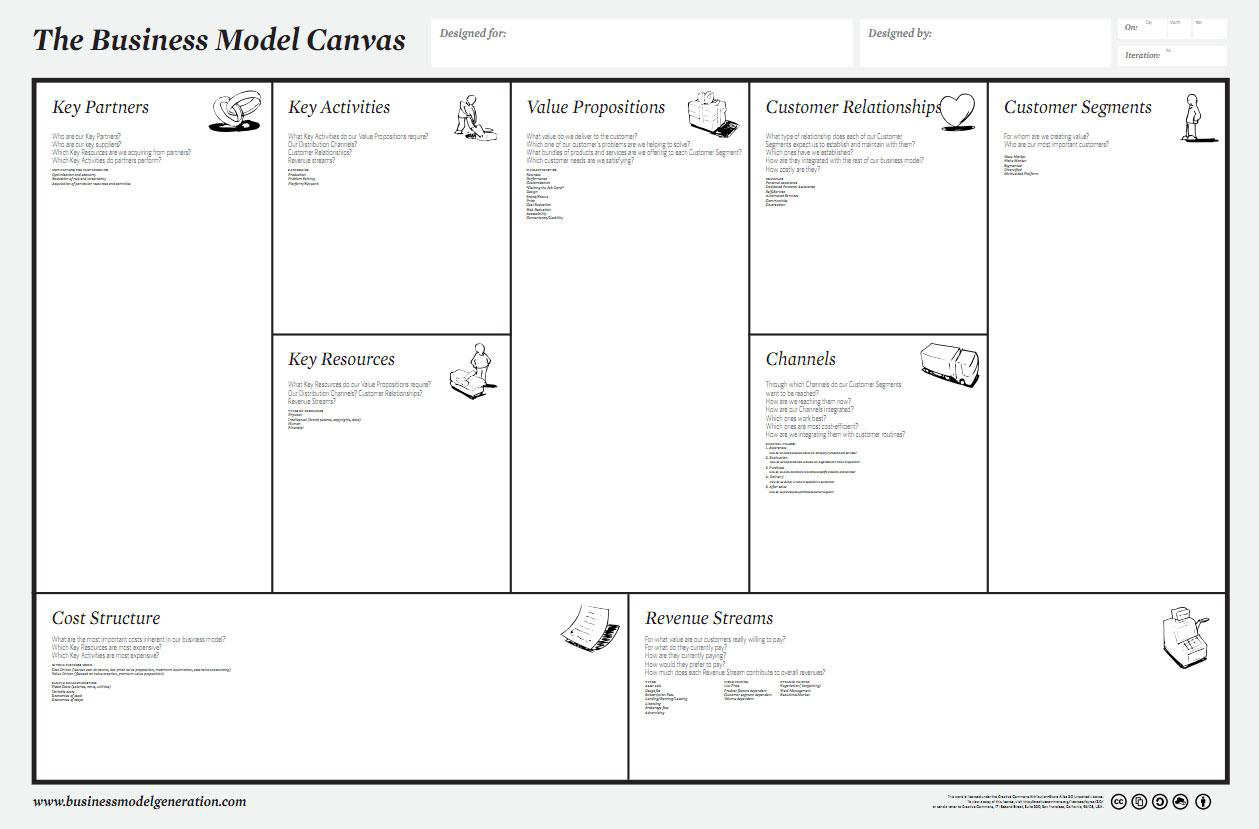
A business model. A business model describes the rationale of how an organization creates, delivers, and captures value. It aims to answer a key question: How do you plan to make money? Current literature on business models, especially in start-up environments, is overwhelmed by the business model canvas methodology from Alexander Osterwalder.
The Business Model Canvas reflects systematically on any business from 9 blocks perspective, enabling both new and existing businesses to focus not only on the business operations but also in its management and marketing dimensions. The 9 blocks (with their corresponding basic questions) are as follows:
o Key partners: Who are your key partners/suppliers? What are the motivations for the partnerships?
o Key activities: What key activities does your value proposition require? What activities are important the most in distribution channels, customer relationships, revenue stream…?
o Value Proposition: What core value do you deliver to the customer? Which customer needs are you satisfying?
o Customer Relationship: What relationship that the target customer expects you to establish? How can you integrate that into your business in terms of cost and format?
o Customer Segment: Which classes are you creating values for? Who is your most important customer?
o Key Resources: What key resources does your value proposition require? What resources are important the most in distribution channels, customer relationships, revenue stream…?
o Distribution Channel: Through which channels that your customers want to be reached? Which channels work best? How much do they cost? How can they be integrated into your and your customers’ routines?
o Cost Structure: What are the most cost in your business? Which key resources/ activities are most expensive?
o Revenue Streams: For what value are your customers willing to pay? What and how do they pay? How would they prefer to pay? How much does every revenue stream contribute to the overall revenues?
Source: Access 4 SMEs Toolbox set for SMEs